

Multigenerational Living
Generational Living: How ADUs Keep Families Close
Generational living is an arrangement where two or more adult generations of a family share one property or live in close proximity, such as an aging parent in a backyard ADU beside the main house. It keeps families connected day to day while preserving each generation's independence, privacy, and financial stability.
- Carlos Ferreira
- Published in
- Updated in
- 7-minute read
Who this article is for: Massachusetts homeowners weighing how to house an aging parent or an adult child while keeping each generation independent.
More Massachusetts families are choosing to live close again. Here's how multigenerational living works, why it faded, and how ADUs make it possible without sacrificing independence.
In this article
What is generational living?
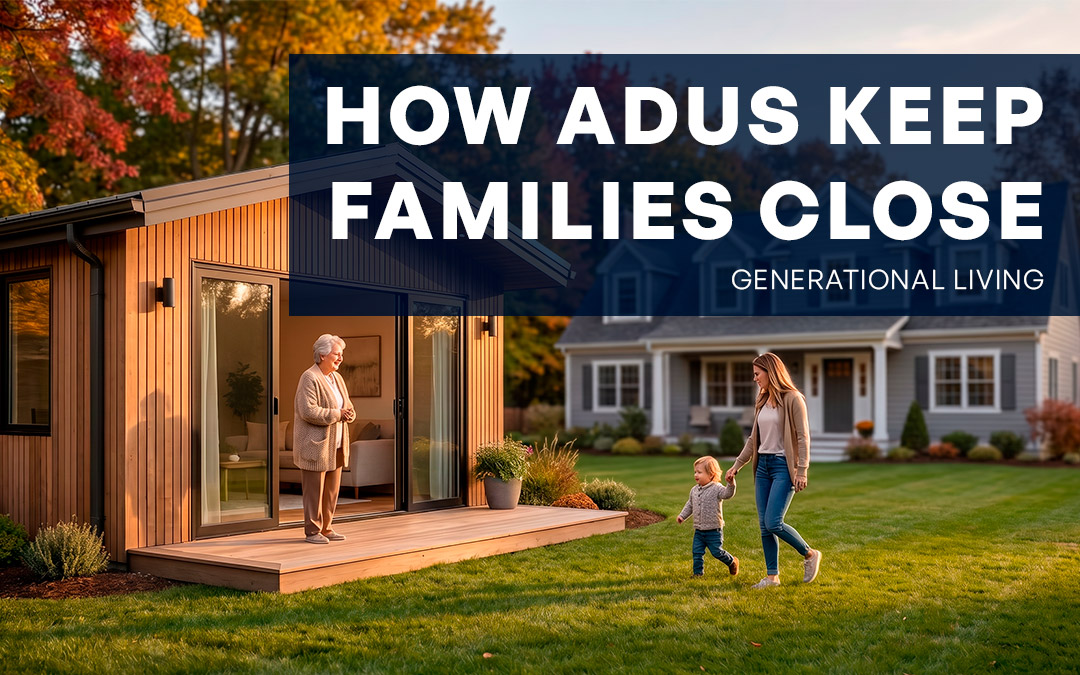
Generational living, also called multigenerational living, is when two or more adult generations of a family share the same property or live within close reach of one another. In practice that might look like an aging parent in a backyard cottage while the kids are in the main house, a young couple renting an accessory unit on their parents’ lot while they save for a home of their own, or grandparents who want to be near their grandchildren without giving up their own space.
It isn’t a new idea. For most of human history, this was simply what “home” meant. What’s new is that families are deliberately choosing it again after decades of moving apart. The distinction that matters is proximity with independence: everyone keeps their own entrance, their own kitchen, and their own routine, while staying close enough to share daily life.
How far apart do American families actually live today?
The average American adult lives about 18 miles from their mother, according to U.S. Census Bureau research, a distance that sounds manageable until full-time work, children, and daily logistics turn it into an entirely separate life. For families with aging parents or emerging health needs, that gap carries real consequences.
The bigger shift is generational. The Pew Research Center reports that multigenerational households fell from about 21% of the U.S. population in 1950 to roughly 12% by 1980, as the independent nuclear family became the ideal. That trend has since reversed: by the early 2020s, about 26% of Americans, roughly 59 million people, lived in multigenerational households, the highest share since the 1950s.
In Massachusetts, cost compounds the distance. Care and rent in Greater Boston push more families to look for alternatives close to home:
| Housing option (Greater Boston) | Typical monthly cost |
|---|---|
| Assisted living / memory care | $5,000–$8,000 |
| One-bedroom apartment rental | $2,500+ |
Why did families drift apart in the first place?
Families didn’t grow distant because they stopped caring; they grew distant because the systems around them were built for exactly that outcome. The separation was structural, not personal.
- Work concentrated opportunity in specific cities. Meaningful employment clustered in certain metros and industries, and young adults followed it wherever it led.
- Housing costs made proximity unaffordable. In high-cost markets like Massachusetts, adult children often couldn’t afford to live near their parents even when they wanted to.
- Culture equated distance with success. “Making it on your own” quietly came to mean making it somewhere else.
- Institutional care became the default. As parents aged, assisted living became the path of least resistance, often at the cost of daily connection and financial stability.
The pattern wasn’t designed for families to stay together. It was designed for individuals to move on, and only recently has that started to reverse.
What are the real benefits of multigenerational living?
The benefits of multigenerational living are well documented across financial, health, and social dimensions, and they cut in every direction of the family.
- For adult children and young families: lower housing costs without losing privacy, a built-in support network for childcare and emergencies, and the ability to build savings while staying connected.
- For aging parents: independence with security nearby. Social isolation is one of the leading risk factors for cognitive decline in older adults, and living close to family, without losing autonomy, addresses that directly, at a fraction of the cost of institutional care.
- For the family as a whole: children grow up with grandparents as part of daily life, caregiving is shared naturally instead of outsourced, and connection becomes routine rather than something that requires a flight and a hotel.
Being close doesn’t mean living on top of each other. With the right setup, it means being there when it counts while everyone keeps their own space.
How do ADUs make generational living possible in Massachusetts?
An Accessory Dwelling Unit (ADU) is an independent home built on the same lot as a primary house, with its own entrance, kitchen, and bathroom, and it is the most practical way most Massachusetts families make generational living work. A parent can live in a backyard unit with full independence while being seconds from family; an adult child can build financial stability while saving for a home of their own.
A recent legal change made this far more accessible. The Affordable Homes Act, passed in 2024, established ADUs as a by-right use in 177 MBTA communities across Massachusetts, meaning homeowners in most of Greater Boston no longer need special zoning approval to build one. The largest regulatory barrier that used to hold families back has been removed.
Building one still has to be manageable. MassDwell designs and builds modular ADUs for Massachusetts properties on a fully turnkey basis, handling assessment, permitting, factory production, delivery, and installation. Every model is delivered in 8 to 12 weeks and built to Massachusetts code, so the homeowner makes decisions rather than managing a construction site.
Frequently asked questions
Is an ADU the same as an in-law suite?
Not quite. An in-law suite is usually a converted room or addition that shares the main home’s entrance and systems. An ADU is a fully independent unit with its own entrance, kitchen, and bathroom, which is what lets a family member live close while keeping real day-to-day independence.
Can I rent out the ADU instead of housing a family member?
Yes. Many Massachusetts homeowners use an ADU for a parent or adult child first, then rent it later as needs change. Under the 2024 Affordable Homes Act, ADUs are allowed by-right in 177 MBTA communities, though local rules on rentals can still vary, so it’s worth confirming with your town.
What happens to the ADU when my parent no longer needs it?
It stays a flexible asset. Families commonly shift an ADU from housing a parent to a home office, a space for a returning adult child, or a rental that generates income. Because it’s a permanent, code-built structure on your lot, it keeps serving the household long after the original need changes.
How long does it take to build a modular ADU?
MassDwell delivers each modular ADU in 8 to 12 weeks, built to Massachusetts code, depending on permitting and site prep. Because the unit is produced in a factory while site work happens in parallel, your yard isn’t a construction zone for a year the way traditional building often requires.
Is an ADU the same as an in-law suite?
Not quite. An in-law suite is usually a converted room or addition that shares the main home’s entrance and systems. An ADU is a fully independent unit with its own entrance, kitchen, and bathroom, which is what lets a family member live close while keeping real day-to-day independence.
Can I rent out the ADU instead of housing a family member?
Yes. Many Massachusetts homeowners use an ADU for a parent or adult child first, then rent it later as needs change. Under the 2024 Affordable Homes Act, ADUs are allowed by-right in 177 MBTA communities, though local rules on rentals can still vary, so it’s worth confirming with your town.
What happens to the ADU when my parent no longer needs it?
It stays a flexible asset. Families commonly shift an ADU from housing a parent to a home office, a space for a returning adult child, or a rental that generates income. Because it’s a permanent, code-built structure on your lot, it keeps serving the household long after the original need changes.
How long does it take to build a modular ADU?
MassDwell delivers each modular ADU in 8 to 12 weeks, built to Massachusetts code, depending on permitting and site prep. Because the unit is produced in a factory while site work happens in parallel, your yard isn’t a construction zone for a year the way traditional building often requires.
Related Posts

Contact Us
Let's Get in
Touch
We offer transparent pricing based on model, finish level and site conditions. Request a quote and we’ll provide a detailed estimate tailored to your property.
Yes, and we take care of that for you. Our team handles all local zoning checks, permitting and approvals so you can build without the paperwork hassle.
From initial approval to on-site installation, most projects are completed within 8–12 weeks, depending on permitting and site prep.