

Modular Construction
Cold-Formed Steel vs. Wood Framing for Modular Homes
Cold-formed steel framing is a structural system made from precision, galvanized light-gauge steel profiles, used in modular construction as an alternative to wood studs. Compared with wood framing, it resists fire, pests, moisture, and extreme weather, lasts 100 or more years with minimal maintenance, and holds tighter factory tolerances.
- Carlos Ferreira
- Published in
- Updated in
- 7-minute read
Who this article is for: homeowners and builders planning a modular home or ADU who want to understand how steel and wood framing compare.
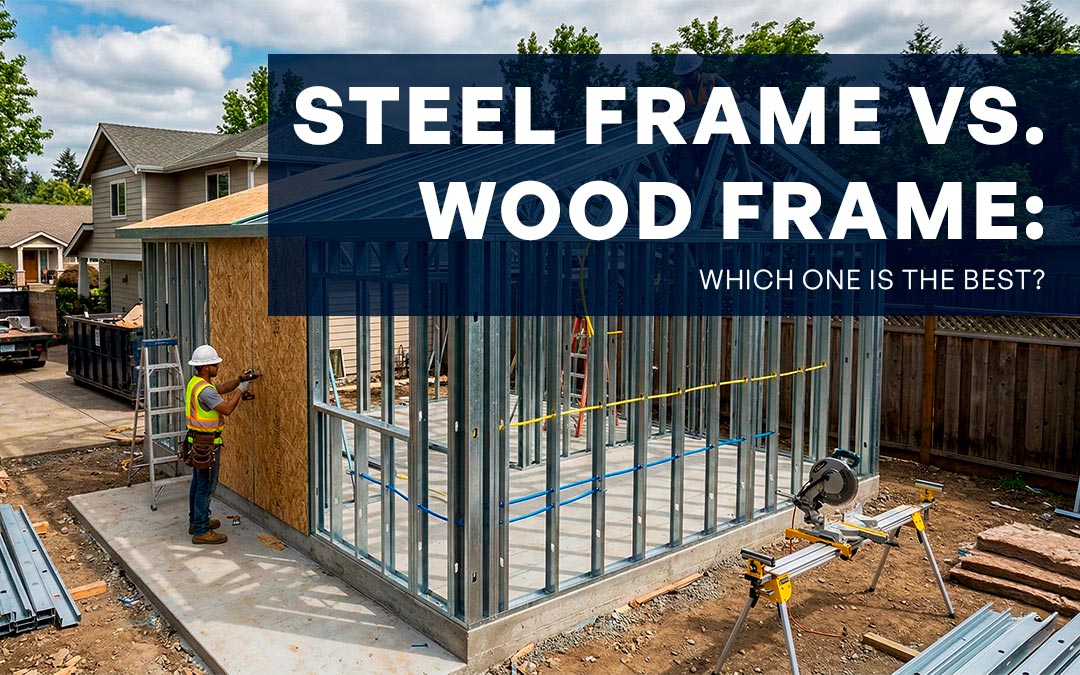
Cold-formed steel and wood framing behave very differently in modular builds. Here's how they compare on durability, resistance, precision, energy performance, and long-term cost.
In this article
- Introduction
- What’s the difference between cold-formed steel and wood framing?
- Which framing lasts longer, steel or wood?
- How does steel framing hold up to fire, pests, moisture, and extreme weather?
- Is steel framing precise and energy-efficient in modular construction?
- Is steel framing faster and more cost-effective over time?
- Frequently asked questions
What’s the difference between cold-formed steel and wood framing?
The two systems differ in what they’re made of and how they behave. Wood framing uses engineered lumber studs, usually pine, spruce, or I-joists, with OSB sheathing; it’s lightweight, flexible, and has been the default for U.S. residential construction for generations. Cold-formed steel framing is built from precision roll-formed, galvanized light-gauge steel profiles, CNC-cut to millimeter accuracy and assembled into rigid panels ready for fast modular installation, whether the project is a full home or an ADU.
The material behavior is where they split. Wood is renewable and naturally insulating, but as an organic material it reacts to moisture, temperature swings, and biological threats like termites and mold, which are common concerns across many U.S. climates. Cold-formed steel is inorganic, non-combustible, and 100% recyclable, and its factory-applied galvanization provides decades of corrosion protection even in coastal or humid environments. Both work in modular and prefab builds, but steel stands out for dimensional stability and engineered consistency.
Which framing lasts longer, steel or wood?
Quality steel-framed structures routinely last 100 or more years with virtually no structural maintenance, because steel does not rot, warp, shrink, crack, or settle. Its strength-to-weight ratio also allows larger open spans, taller ceilings, and more flexible layouts while keeping the structure light.
Wood framing can perform well, but even when properly treated it needs ongoing protection against pests and moisture, especially in variable U.S. climates. According to BuildSteel, an industry resource for cold-formed steel, that low-maintenance longevity is one of steel’s central structural advantages over wood.
How does steel framing hold up to fire, pests, moisture, and extreme weather?
Steel outperforms wood across the threats that damage homes most, which is a large part of why it’s chosen for demanding sites.
- Fire: steel is non-combustible. It doesn’t fuel flames and holds structural integrity longer when protected with standard gypsum assemblies, which matters in wildfire-prone areas.
- Pests and moisture: steel is completely immune to termites, mold, rot, and carpenter ants. Termites alone cause billions of dollars in damage across the U.S. each year.
- Storms and earthquakes: its controlled flexibility and high strength help buildings withstand high winds, seismic activity, and heavy snow loads more effectively than traditional wood framing.
Is steel framing precise and energy-efficient in modular construction?
Yes, and precision is steel’s biggest edge in factory building. CNC-cut components produce perfectly straight walls, square corners, and exact door and window openings, which means tighter building envelopes, fewer on-site adjustments, and a higher-quality finished home. Wood can be accurate too, but as Framecad notes in its steel-versus-wood comparison, natural variation in lumber often forces corrections during installation.
The idea that steel “feels cold” or wastes heat is a myth. Properly designed steel-framed homes, with high-performance insulation such as mineral wool, fiberglass, or closed-cell foam plus thermal breaks, meet or exceed IECC energy codes. The rigidity of steel framing also allows superior air sealing, which improves thermal efficiency and delivers strong sound control in both suburban and urban settings.
Is steel framing faster and more cost-effective over time?
Modular steel construction can cut overall project timelines by 50 to 70% versus traditional site-built homes. Its lighter weight often allows smaller, more cost-effective foundations and up to 75% less on-site waste, and steel is one of the most recycled materials in the world. Upfront material cost can be comparable to or slightly higher than wood, but total cost of ownership is usually lower thanks to reduced maintenance, potential insurance savings, and exceptional longevity.
Put together, that’s why cold-formed steel is the smarter structural choice for most modular projects:
- Durability: 100+ year lifespan with minimal structural maintenance.
- Total resistance: immune to fire, termites, mold, and extreme weather.
- Factory precision: superior finish and consistent structural performance.
- Energy efficiency: insulation compatibility and improved air sealing.
- Faster builds: shorter timelines and cleaner job sites.
- Long-term value: lower maintenance and potential insurance benefits.
For an ADU, pairing that durability with the right unit for your lot is what turns a strong structure into a home that fits your life.
Frequently asked questions
Does MassDwell build with steel or wood framing?
MassDwell builds its modular ADUs with cold-formed steel framing rather than wood. That’s what allows the precise factory tolerances, the fire and pest resistance, and the long, low-maintenance lifespan described above, all delivered to Massachusetts code in a modular build.
Does a steel-framed home interfere with WiFi or cell signal?
No. Steel framing does not meaningfully block WiFi or cellular signal in a normally designed home, since signals travel through windows, doors, and the gaps between framing members. Modern routers and standard layouts handle steel-framed interiors without any special equipment.
Is cold-formed steel a good fit for ADUs specifically?
Yes. ADUs benefit especially from steel’s tight footprint precision, larger open spans, and low maintenance, since the units are compact and often placed close to a main house. Steel also speeds up the modular timeline, which keeps a backyard build short and clean.
Once it’s finished, can you tell a home is steel-framed?
Usually not. Once insulation, drywall, and finishes are in place, a steel-framed home looks and feels like any other home from the inside. The framing shapes performance and durability, not the visible finishes, flooring, or layout you live with day to day.
Does MassDwell build with steel or wood framing?
MassDwell builds its modular ADUs with cold-formed steel framing rather than wood. That’s what allows the precise factory tolerances, the fire and pest resistance, and the long, low-maintenance lifespan described above, all delivered to Massachusetts code in a modular build.
Does a steel-framed home interfere with WiFi or cell signal?
No. Steel framing does not meaningfully block WiFi or cellular signal in a normally designed home, since signals travel through windows, doors, and the gaps between framing members. Modern routers and standard layouts handle steel-framed interiors without any special equipment.
Is cold-formed steel a good fit for ADUs specifically?
Yes. ADUs benefit especially from steel’s tight footprint precision, larger open spans, and low maintenance, since the units are compact and often placed close to a main house. Steel also speeds up the modular timeline, which keeps a backyard build short and clean.
Once it’s finished, can you tell a home is steel-framed?
Usually not. Once insulation, drywall, and finishes are in place, a steel-framed home looks and feels like any other home from the inside. The framing shapes performance and durability, not the visible finishes, flooring, or layout you live with day to day.
Related Posts
Contact Us
Let's Get in
Touch
We offer transparent pricing based on model, finish level and site conditions. Request a quote and we’ll provide a detailed estimate tailored to your property.
Yes, and we take care of that for you. Our team handles all local zoning checks, permitting and approvals so you can build without the paperwork hassle.
From initial approval to on-site installation, most projects are completed within 8–12 weeks, depending on permitting and site prep.