

ADU Planning
What Kind of ADU Fits Your Life?
The right ADU is the one that fits how you plan to use it, the size and shape of your lot, and your budget, rather than a fixed style or square footage. The main decisions are its purpose, number of floors, bedroom count, footprint shape, and architectural style, each pointing toward rental income, family housing, or flexible use.
- Carlos Ferreira
- Published in
- Updated in
- 7-minute read
Who this article is for: Massachusetts homeowners deciding which ADU type, size, and style fits their property and how they plan to use it.
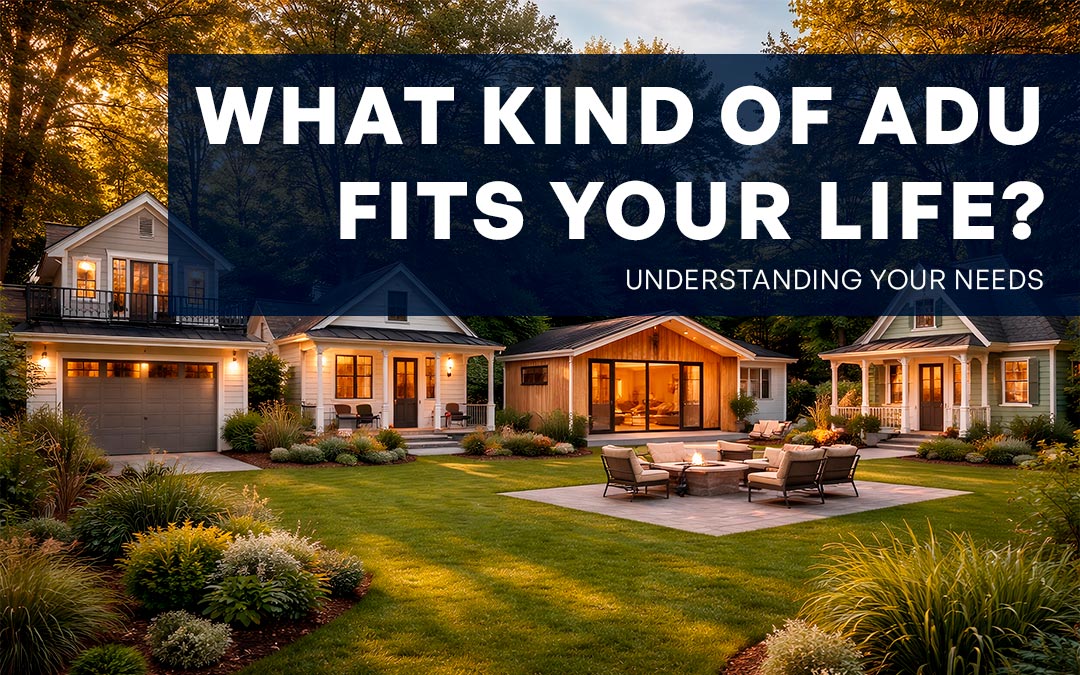
The right ADU depends on how you'll use it, your lot, and your budget. Here's how to match purpose, floors, bedrooms, shape, and style to your property.
In this article
What should you decide first when choosing an ADU?
Start with purpose: what you need the ADU to do drives every other decision. Most homeowners fall into one of three goals, and each points toward a different configuration.
- Rental income: efficiency matters. A well-designed one-bedroom or compact two-bedroom keeps the footprint practical while maximizing appeal and property value.
- Family use: housing aging parents, an adult child, or supporting multigenerational living calls for accessibility, privacy, and a layout that feels like a real home.
- Flexible space: a guest house or office today that can become a rental or family unit later. Here, versatility should guide the floor plan.
Once purpose is clear, the rest becomes a process of elimination. Here is the quick way to match a goal to a configuration:
| Your goal | Best-fit ADU |
|---|---|
| Rental income | 1 bed / 1 bath or efficient 2 bed / 1 bath, one-story, clean modern footprint |
| Aging parents | One-story, 1–2 bedrooms, ranch or farmhouse style, easy circulation |
| Multigenerational living | 2 bed / 1 bath or 2 bed / 2 bath, square or fuller-home layout, familiar residential style |
| Compact lots | Two-story or garage-based, efficient footprint, proportional style |
| Flexibility over time | 2 bedrooms, adaptable layout, balanced shape, timeless style |
Should you build a one-story, two-story, or garage ADU?
The form of the ADU, one floor, two floors, or built around a garage, depends mostly on your lot and how much yard you want to keep. Each option solves a different constraint.
- One-story: best for simplicity, accessibility, and aging in place. Ideal for aging parents, long-term rentals, guest houses, and smaller households that want easy indoor-outdoor flow.
- Two-story: maximizes living space on a smaller footprint. A strong fit for narrow or constrained lots, preserving yard space, and creating a fuller, standalone-home feel.
- Garage-based: converting an existing garage or building living space above a new one. Useful when you need parking or storage below and living space above.
In Massachusetts, internal and attached ADU types are allowed, and garage conversions can be part of the conversation depending on site conditions and code. Since the 2024 Affordable Homes Act made ADUs a by-right use in many communities, more of these options are open without special zoning approval. If you are still weighing what an ADU can be on your lot, start with the basics of what an ADU is.
How many bedrooms and bathrooms does your ADU need?
Bedroom count should follow who will actually use the space, not preference, and it maps directly to MassDwell’s models. Three configurations cover most needs.
- 1 bed / 1 bath: ideal for solo renters, couples, guests, or a home office with occasional living use, and the most budget-efficient footprint. MassDwell’s Dwell Essential is a compact, single-story modern steel ADU with 1 bedroom and 1 bathroom.
- 2 bed / 1 bath: more flexible and broadly appealing, good for small families, roommates, an adult child plus office, or long-term guests. This is where Dwell Classic and Dwell Deluxe fit.
- 2 bed / 2 bath: best when privacy and comfort matter, especially for multigenerational households and higher-end rentals. Dwell Prime is the largest current model, with 2 bedrooms and 2 bathrooms, built up to the 900 sq ft limit.
If you expect the ADU’s use to change over time, two bedrooms give you the most room to adapt.
What shape and layout works best for your lot?
Shape affects more than looks: it drives furniture layout, flow, perceived space, and how the ADU sits on the lot. Three footprints cover most Massachusetts properties.
- Box / rectangular: efficient on narrow lots and for sequential, linear layouts. Reads clean and modern, and pairs well with streamlined modular construction.
- Square: feels balanced and residential, with centered living layouts, even room proportions, and compact circulation. Often feels softer next to an existing single-family home.
- L-shaped: opens the home toward outdoor space and adds privacy. Works well when you want to separate living and sleeping areas or wrap the unit around a patio or deck.
If the priority is for the ADU to feel like a natural part of the property rather than an add-on, square or L-shaped footprints tend to feel the most intentional.
Which architectural style fits your property?
Style should make the ADU feel intentional and compatible with the main house, not like an afterthought. Five styles cover most Massachusetts neighborhoods.
- Colonial: symmetrical and timeless, blends quietly into traditional New England settings.
- Ranch: low-profile and practical, a strong fit for single-story living, aging in place, and suburban lots.
- Cape: warm and compact, with familiar curb appeal that suits many Massachusetts neighborhoods.
- Victorian: more expressive and decorative, best for historic or character-rich areas where design is part of the appeal.
- Farmhouse: welcoming and familiar, bridging classic comfort with cleaner current lines for family-oriented or semi-rural lots.
Whichever direction you choose, the goal is for the ADU to complement the main home rather than compete with it. Matching style to your property is the final step in turning a general idea into a unit that fits your life.
Frequently asked questions
How big can an ADU be in Massachusetts?
Massachusetts allows detached ADUs up to 900 square feet by right under the 2024 Affordable Homes Act, and local rules can permit more in some cases. MassDwell’s largest current model, Dwell Prime, is built to that 900 sq ft limit, while smaller models suit tighter lots or budgets.
Will adding an ADU increase my property value?
An ADU typically adds both usable space and long-term value, since it can serve as rental income, family housing, or flexible living space over time. Financing options for ADUs in Massachusetts have also expanded, which makes adding one easier than many homeowners expect.
How long does it take to build a modular ADU?
MassDwell delivers each modular ADU in 8 to 12 weeks, built to Massachusetts code, depending on permitting and site prep. Because the unit is produced in a factory while site work happens in parallel, your property isn’t a construction zone for months the way traditional building often is.
Can I change how I use the ADU later on?
Yes. Many homeowners start with a guest house or home office and later shift the same ADU to a rental or family unit. Choosing a flexible layout, usually two bedrooms and a balanced shape, makes it easier for the space to adapt as your needs change.
How big can an ADU be in Massachusetts?
Massachusetts allows detached ADUs up to 900 square feet by right under the 2024 Affordable Homes Act, and local rules can permit more in some cases. MassDwell’s largest current model, Dwell Prime, is built to that 900 sq ft limit, while smaller models suit tighter lots or budgets.
Will adding an ADU increase my property value?
An ADU typically adds both usable space and long-term value, since it can serve as rental income, family housing, or flexible living space over time. Financing options for ADUs in Massachusetts have also expanded, which makes adding one easier than many homeowners expect.
How long does it take to build a modular ADU?
MassDwell delivers each modular ADU in 8 to 12 weeks, built to Massachusetts code, depending on permitting and site prep. Because the unit is produced in a factory while site work happens in parallel, your property isn’t a construction zone for months the way traditional building often is.
Can I change how I use the ADU later on?
Yes. Many homeowners start with a guest house or home office and later shift the same ADU to a rental or family unit. Choosing a flexible layout, usually two bedrooms and a balanced shape, makes it easier for the space to adapt as your needs change.
Related Posts
Contact Us
Let's Get in
Touch
We offer transparent pricing based on model, finish level and site conditions. Request a quote and we’ll provide a detailed estimate tailored to your property.
Yes, and we take care of that for you. Our team handles all local zoning checks, permitting and approvals so you can build without the paperwork hassle.
From initial approval to on-site installation, most projects are completed within 8–12 weeks, depending on permitting and site prep.